
Table of Contents
- Hello dear readers
- This text is not about women but about
- nonbinary people
- because nonbinary gender is narrowly visible and included in the current German Language System
- leading to inhibiting (self-) expression
- and (self-) identification.
- If nonbinary people can't freely unfold their personality, nobody can.
- Conclusion, Outlook and Get Active
- References
Hint
Read the headings in sequence to understand the argument.Sex/gender is ancient history
“Our results demonstrate that regardless of the cause of observed sex/gender differences in brain and behavior (nature or nurture), human brains cannot be categorized into two distinct classes: male brain/female brain. ”Joel et al. (2015)
Note
sex/gender = The biosocial entwinement of sex and gender. DuBois & Shattuck-Heidorn (2021)Note
If some single headings seem incomplete, it's because they are—just like the way nonbinary people are often left without full expression in German language.Generic masculine is asymmetrical
Many scientists reject the supposed generic masculine form because of its linguistic gender asymmetry (Pusch, 1991; Martyna, 1980; Prewitt-Freilino et al., 2011). Linguistic asymmetry signifies that men have a chance twice as high as women to be referred to(Pusch, 1991).
Note
The third person plural "they/them" translates to German as "sie," which is similar to the third person singular form "sie" (she) in German.Note
Another popular neopronoun is “dey/dej,” which is derived from the English they.Lind (2022)
The Self-Determination Law,
Before, only intersex
individuals were allowed
to update their sex entry,
and the reason for this
restriction was not
explained. Registrars had
to review applications to
check for correctness and
could impose fines if
necessary. However, there
was no evidence for a
clear distinction between
transgender and intersex
identities (Lind, 2022).
The representation of nonbinary gender in the German Language System
Prologue
Let us begin this blog entry by traveling back to the sixties. We find ourselves in a cozy room where a group of women sits together in a relaxed manner, chatting softly, with the sound of a crackling fireplace in the background. One woman raises her glass, and the other conversations fall silent. She introduces herself to the newcomers and begins to speak.A year ago, she had a baby. During her pregnancy, she experienced extreme sadness, low energy, and anxiety, often crying. When she gave birth, she expected her bad mood to disappear. She would become a mother. Isn’t this the greatest thing in the world? However, she did not get better. She felt emptiness. And guilt. Her husband judged her, the poor baby; what kind of a woman was she? Everybody must think that she was a terrible mother.
Another woman looked up with tears in her eyes, surprised to learn she was not alone. She could relate to the previous story and began to share her own experiences. It turned out that many of these women were experiencing similar feelings. All were isolated and suffering in silence, believing they were the only ones struggling and thinking that they would be terrible mothers. They were completely in the dark about what was happening to them.
Out of such group sharing arouse the term postpartum depression. Finally, women knew that there was a medical explanation for their discomfort and that it was not a reflection of their failure as mothers. They could continue developing the self because they could self-express themselves.
Hello dear readers
I chose this entrance to stress that essential terms for self-expression, which seem natural to us nowadays, were not 40 years ago. This lack of expression and intertwined epistemic knowledge gap continue to exist until today. The good news is that cognitive scientists are the perfect candidates to detect further inequalities. Why? Because cognitive science has a multifaceted perspective on the mind. Its interdisciplinary approach includes relevant fields such as linguistics, psychology, neuroscience, and philosophy.This text is not about women, but about
Especially today, we know that the idea of binary sex/gender is ancient history, which is why we are not done when solely looking at the representation and freedom of self-expression concerning women. Language simultaneously creates a form of reality and self-image. She functions as a central, communicative practice (Kalwa, 2022). Over decades, there has been a gendering debate, initially to ensure the symmetric visibility of women (Pusch,1991; Lind, 2022), but later to include all genders (Lind, 2022).In this text, we cognitive scientists will look together at the representation of nonbinary gender in the German Language System. I state that nonbinary gender is narrowly visible and included in the current German Language System, which inhibits the (self-) expression and identification of nonbinary people.
nonbinary people
First, I want to clarify further what I mean when discussing nonbinarity. Nonbinarity refers to the gendered interspace between the traditionally established categories “female” and “male” and the settlement within the interspace (Lind, 2022). The orientation and designation in the interspace vary and result in various identifications, for instance, agender, genderfluid, genderqueer, and nonbinary.These positions resist the containment to either the category “female” or “male” and deliver space for non-female or non-male self-concepts (Lind, 2022). In a certain way, the “betwixt and between” position of individuals signifies social and physical invisibility because they lie by definition outside of definitions and are, therefore, not tangible (Lind, 2022).
I hope everyone is on the same page now regarding the term nonbinarity so we can move forward with inspecting the German language system.
because nonbinary gender is narrowly visible and included in the current German Language System
German is classified as a grammatical gender language (Stahlberg et al., 2007; Prewitt-Freilino et al., 2011). Thus, German is “[…] characterized by [its] nouns, which are always assigned a feminine or masculine (or sometimes neuter) gender.“ (Prewitt-Freilino et al., 2011).Furthermore, the masculine form is meant to serve as a generic term, but only in terms of binary grammatical gender. German lacks sufficient vocabulary to adequately express nonbinary distinctions. As a result, there is a lack of proper designations (Diewald & Nübling, 2022).
leading to inhibiting (self-) expression
In the previous section, we learned that German is a grammatical gender language, meaning that its nouns play a central role in sentence construction. However, it is important to note that other grammatical components, such as pronouns, also adapt to grammatical gender. Therefore, gendering the noun is only one aspect of creating a nonbinary inclusive language system.Individual gender transitions are characterized by symbolic rituals that highlight the abandonment of the old and the entrance into a new classification system. These rituals include linguistic practices like changing the first name and pronouns or determining self-designations (Lind, 2022).
The traditional German binary name system with few gender-neutral prenames inhibits the name search (Lind, 2022).
Furthermore, until 2008, individuals could only use a gender-neutral first name if they also had a second gender-specific name (Lind, 2022). Nevertheless, the application process remains difficult and expensive because registrars often reject gender-neutral first names. If this happens, the concerned individual needs to file an objection to get approval from a higher authority (Schmuck, 2019).
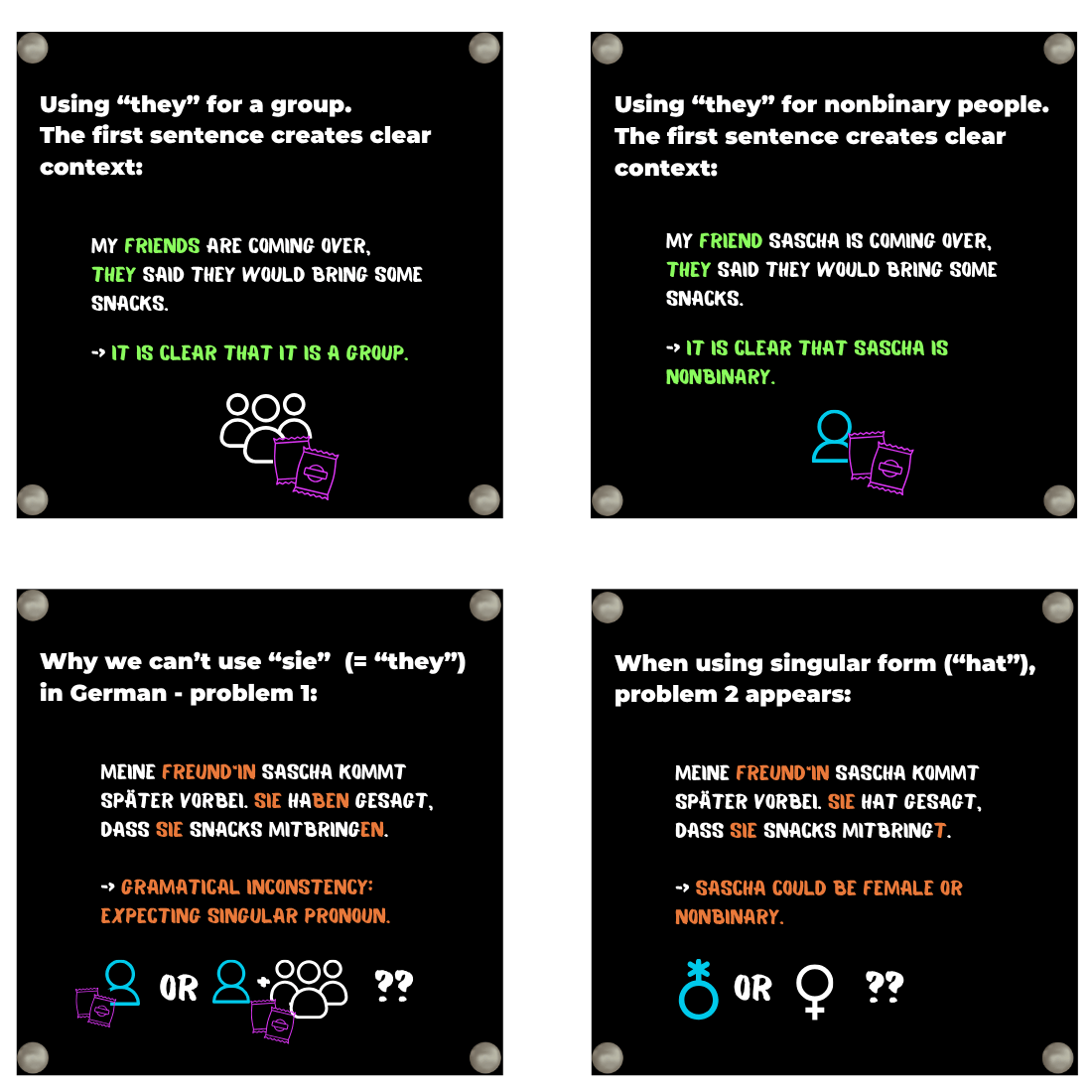
The third-person singular presents a challenge. In rare cases, nonbinary people use the neuter form, but this approach has little potential due to its devaluative and dehumanizing semantics (Lind, 2022). In English, nonbinary people use the third person plural “they/them.” In German, sharing the exact spelling with the feminine singular pronoun inhibits this alternative (Lind, 2022):
As a result, nonbinary groups have to reinvent themselves.
Creative innovations, for example, neopronouns like “sier,” “dier,” or “xier” meet rejection from binary society members
(Lind, 2022; Müller-Spitzer, 2022). Many nonbinary individuals try to avoid this negative confrontation and narrow their linguistic identification search (Lind, 2022).
Another concept that can solve the pronoun difficulty is the continuous usage of the prename.
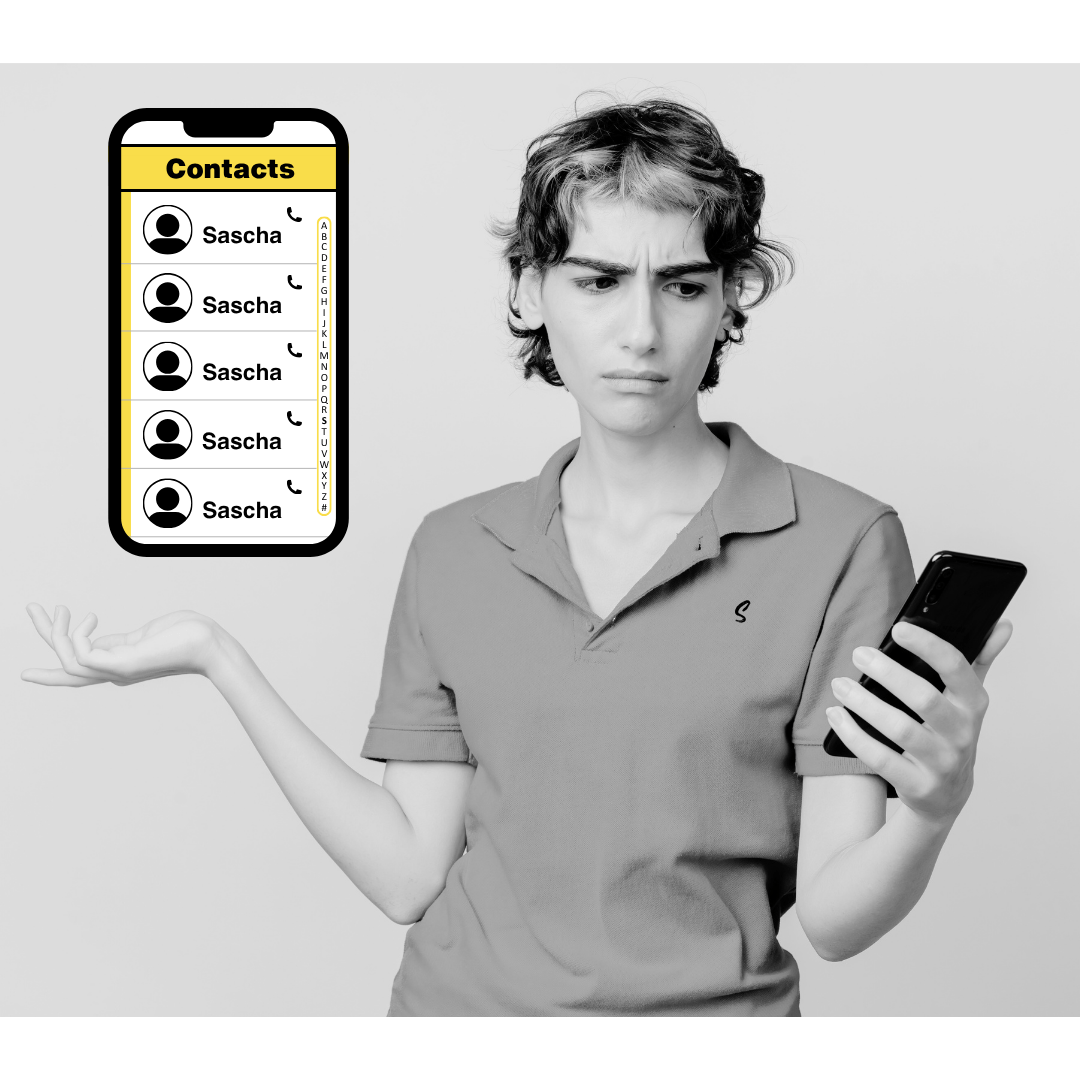
For example: “Sascha ist hungrig. Kannst du Sascha eine Pizza kaufen?” (English: Sascha is hungry. Can you buy Sascha a pizza?).
This concept illustrates the importance of a sufficient collection of established gender-neutral name choices. Unfortunately, within this concept, it remains inconclusive if the sentences refer to two different Saschas.
A corpus linguistic study by Nina Kalwa (2022) provides evidence for a steady demand for clarity from the young. The study analyzed data from a German nonbinary counseling platform for children and young adults from 12 years old. Notably, it is open to whether the evidence is generally adaptable to nonbinary groups (Kalwa, 2022).
Many individuals feel uncomfortable with the limited self-description to be in-between. Besides, these individuals are uncertain whether they could identify with one of the existing nonbinary categories.
A contribution to this uncertainty is the fact that nonbinary categories are not established, which can make identification difficult (Kalwa, 2022). Since identity development is a central component of adolescence (Lohaus & Vierhaus, 2019) and language and identity are connected (Reyes, 2013), a label gap can negatively interfere with the development process. The analysis identifies the wish for (new) established nonbinary categories and labels.
The commencement of the Self-Determination Law is a good start, and a time travel to the future will hopefully manifest a successfully established language reform that maps a more realistic image of society regarding gender.
Boroditsky (2011) hypothesizes a mutual influence between language and thought:
Another concept that can solve the pronoun difficulty is the continuous usage of the prename.
For example: “Sascha ist hungrig. Kannst du Sascha eine Pizza kaufen?” (English: Sascha is hungry. Can you buy Sascha a pizza?).
This concept illustrates the importance of a sufficient collection of established gender-neutral name choices. Unfortunately, within this concept, it remains inconclusive if the sentences refer to two different Saschas.
and (self-) identification.
In a coursebook for prospective psychologists, Lohaus and Vierhaus (2019) define the adoption of male or female gender roles as a challenge for adolescents (Lohaus & Vierhaus, 2019). What about nonbinary-gendered youths?A corpus linguistic study by Nina Kalwa (2022) provides evidence for a steady demand for clarity from the young. The study analyzed data from a German nonbinary counseling platform for children and young adults from 12 years old. Notably, it is open to whether the evidence is generally adaptable to nonbinary groups (Kalwa, 2022).
Many individuals feel uncomfortable with the limited self-description to be in-between. Besides, these individuals are uncertain whether they could identify with one of the existing nonbinary categories.
A contribution to this uncertainty is the fact that nonbinary categories are not established, which can make identification difficult (Kalwa, 2022). Since identity development is a central component of adolescence (Lohaus & Vierhaus, 2019) and language and identity are connected (Reyes, 2013), a label gap can negatively interfere with the development process. The analysis identifies the wish for (new) established nonbinary categories and labels.
If nonbinary people can’t freely unfold their personality, nobody can.
“Human dignity and the right to the free development of the personality also include the right to sexual self-determination.” (Bundesministerium der Justiz, 2023) declares the German Federal Ministry of Justice concerning the current conceptualization of a new Self-Determination Law.The commencement of the Self-Determination Law is a good start, and a time travel to the future will hopefully manifest a successfully established language reform that maps a more realistic image of society regarding gender.
We observed...
...the invisibility of nonbinarity in our supposed generic form. We further investigated the issue of limited, complicated usage of nonbinary expressions, such as pronouns, in German. Furthermore, nonbinary people lack a variety of labels to identify with.Boroditsky (2011) hypothesizes a mutual influence between language and thought:
Studies have shown that changing how people talk changes how they think. Teaching people new color words, for instance, changes their ability to discriminate colors. And teaching people a new way of talking about time gives them a new way of thinking about it.
Based on this evidence, a language system that ensures linguistic visibility and generous space for nonbinary expressions could form new nonbinary concepts of thought that might support open-mindedness.
Get Active
- All actions should rely on assertions truly made by nonbinary gender groups.
- Support positive reactions and open-mindedness towards language change and, in general, more awareness of nonbinary gender.
- Under consideration of the requirements to include nonbinary gender.
- Intended gender-fair double forms like “Bürger und Bürgerinnen” (engl. citizen male and female form) (Müller-Spitzer et al., 2022) should fail the suitability check.
References
Boroditsky, L. (2009). How does our language shape the way we think? In M. Brockman (Ed.), What's next? Dispatches on the future of science (pp. 116–129). New York: Vintage.
Boroditsky, L. (2011). How Language Shapes Thought. Scientific American, 304(2), 62–65. http://www.jstor.org/stable/26002395.
Diewald, G. (2018). Zur Diskussion: Geschlechtergerechte Sprache als Thema der germanistischen Linguistik – exemplarisch exerziert am Streit um das sogenannte generische Maskulinum. Zeitschrift Für Germanistische Linguistik, 46(2), 283–299. https://doi.org/10.1515/zgl-2018-0016.
Diewald, G., & Nübling, D. (2022). Genus – Sexus – Gender. Walter de Gruyter GmbH & Co KG.
DuBois, L. Z. & Shattuck‐Heidorn, H. (2021). Challenging the binary: Gender/sex and the bio‐logics of normalcy. American Journal Of Human Biology, 33(5). https://doi.org/10.1002/ajhb.23623.
Joel, D., et al. (2015). Sex beyond the genitalia: The human brain mosaic. Proceedings Of The National Academy Of Sciences, 112(50), 15468–15473. https://doi.org/10.1073/pnas.1509654112.
Kalwa, N. (2022). Uneindeutiges vereindeutigen. Lili – Zeitschrift Für Literaturwissenschaft Und Linguistik, 52(4), 651–667. https://doi.org/10.1007/s41244-022-00273-z.
Lind, M. (2022). Liminalität, Transdifferenz und Geschlecht: Sprachliche Praktiken jenseits von Zweigeschlechtlichkeit. Lili – Zeitschrift Für Literaturwissenschaft Und Linguistik, 52(4), 631–649. https://doi.org/10.1007/s41244-022-00272-0.
Lohaus, A., & Vierhaus, M. (2019). Entwicklungspsychologie des Kindes- und Jugendalters für Bachelor. Springer.
Martyna, W. (1980). Beyond the “he/man” approach: The case for nonsexist language. Signs, 5(3), 482–493. https://doi.org/10.1086/493733.
Müller-Spitzer, C., Rüdiger, J. O., & Wolfer, S. (2022, January 7). Olaf Scholz gendert. Eine Analyse von Personenbezeichnungen in Weihnachts- und Neujahrsansprachen. Linguistische Werkstattberichte. https://lingdrafts.hypotheses.org/2370.
Müller-Spitzer, C. (2022). Der Kampf ums Gendern. Kursbuch, 58(209), 28–45. https://doi.org/10.5771/0023-5652-2022-209-28.
Prewitt-Freilino, J. L., Caswell, T. A., & Laakso, E. K. (2011). The Gendering of Language: A Comparison of Gender Equality in Countries with Gendered, Natural Gender, and Genderless Languages. Sex Roles, 66(3–4), 268–281. https://doi.org/10.1007/s11199-011-0083-5.
Pusch, L. F. (1991). Das Deutsche als Männersprache: Aufsätze und Glossen zur feministischen Linguistik.
Reyes, A. (2013). Don’t touch my language: attitudes toward institutional language reforms. Current Issues in Language Planning, 14(2), 337–357. https://doi.org/10.1080/14664208.2013.812946.
Selbstbestimmungsgesetz. (2023, June 10). Bundesministerium der Justiz. https://www.bmj.de/DE/themen/gesellschaft_familie/queeres_leben/selbstbestimmung/selbstbestimmung_node.html.
Schmuck, M. (2019). Eike, Kim vs. Finley, Rowan: Graduelle Geschlechtsneutralität von Unisexnamen. Der Sprachdienst, 3–4/2019, 136–151.
Stahlberg, D., Braun, F., Irmen, L., & Sczesny, S. (2007). Representation of the Sexes in Language. In K. Fiedler (Ed.), Social communication (pp. 163–187). Psychology Press.
Understanding Nonbinary People: How to Be Respectful and Supportive. (n.d.). A4TE. https://transequality.org/issues/resources/understanding-nonbinary-people-how-to-be-respectful-and-supportive.
Boroditsky, L. (2011). How Language Shapes Thought. Scientific American, 304(2), 62–65. http://www.jstor.org/stable/26002395.
Diewald, G. (2018). Zur Diskussion: Geschlechtergerechte Sprache als Thema der germanistischen Linguistik – exemplarisch exerziert am Streit um das sogenannte generische Maskulinum. Zeitschrift Für Germanistische Linguistik, 46(2), 283–299. https://doi.org/10.1515/zgl-2018-0016.
Diewald, G., & Nübling, D. (2022). Genus – Sexus – Gender. Walter de Gruyter GmbH & Co KG.
DuBois, L. Z. & Shattuck‐Heidorn, H. (2021). Challenging the binary: Gender/sex and the bio‐logics of normalcy. American Journal Of Human Biology, 33(5). https://doi.org/10.1002/ajhb.23623.
Joel, D., et al. (2015). Sex beyond the genitalia: The human brain mosaic. Proceedings Of The National Academy Of Sciences, 112(50), 15468–15473. https://doi.org/10.1073/pnas.1509654112.
Kalwa, N. (2022). Uneindeutiges vereindeutigen. Lili – Zeitschrift Für Literaturwissenschaft Und Linguistik, 52(4), 651–667. https://doi.org/10.1007/s41244-022-00273-z.
Lind, M. (2022). Liminalität, Transdifferenz und Geschlecht: Sprachliche Praktiken jenseits von Zweigeschlechtlichkeit. Lili – Zeitschrift Für Literaturwissenschaft Und Linguistik, 52(4), 631–649. https://doi.org/10.1007/s41244-022-00272-0.
Lohaus, A., & Vierhaus, M. (2019). Entwicklungspsychologie des Kindes- und Jugendalters für Bachelor. Springer.
Martyna, W. (1980). Beyond the “he/man” approach: The case for nonsexist language. Signs, 5(3), 482–493. https://doi.org/10.1086/493733.
Müller-Spitzer, C., Rüdiger, J. O., & Wolfer, S. (2022, January 7). Olaf Scholz gendert. Eine Analyse von Personenbezeichnungen in Weihnachts- und Neujahrsansprachen. Linguistische Werkstattberichte. https://lingdrafts.hypotheses.org/2370.
Müller-Spitzer, C. (2022). Der Kampf ums Gendern. Kursbuch, 58(209), 28–45. https://doi.org/10.5771/0023-5652-2022-209-28.
Prewitt-Freilino, J. L., Caswell, T. A., & Laakso, E. K. (2011). The Gendering of Language: A Comparison of Gender Equality in Countries with Gendered, Natural Gender, and Genderless Languages. Sex Roles, 66(3–4), 268–281. https://doi.org/10.1007/s11199-011-0083-5.
Pusch, L. F. (1991). Das Deutsche als Männersprache: Aufsätze und Glossen zur feministischen Linguistik.
Reyes, A. (2013). Don’t touch my language: attitudes toward institutional language reforms. Current Issues in Language Planning, 14(2), 337–357. https://doi.org/10.1080/14664208.2013.812946.
Selbstbestimmungsgesetz. (2023, June 10). Bundesministerium der Justiz. https://www.bmj.de/DE/themen/gesellschaft_familie/queeres_leben/selbstbestimmung/selbstbestimmung_node.html.
Schmuck, M. (2019). Eike, Kim vs. Finley, Rowan: Graduelle Geschlechtsneutralität von Unisexnamen. Der Sprachdienst, 3–4/2019, 136–151.
Stahlberg, D., Braun, F., Irmen, L., & Sczesny, S. (2007). Representation of the Sexes in Language. In K. Fiedler (Ed.), Social communication (pp. 163–187). Psychology Press.
Understanding Nonbinary People: How to Be Respectful and Supportive. (n.d.). A4TE. https://transequality.org/issues/resources/understanding-nonbinary-people-how-to-be-respectful-and-supportive.
Note
The prologue-scene is fictional but based on an example of the US women's liberation movement (late 1960-1980), mentioned by Miranda Fricker in her book “Epistemic Injustice”.Note
The term “nonbinary” has been introduced by the National Center for Transgender Equality :”People whose gender is not male or female use many different terms to describe themselves, with nonbinary being one of the most common (sometimes spelled with a hyphen, as “non-binary”). Other terms include genderqueer, agender, bigender, genderfluid, and more. None of these terms mean exactly the same thing – but all speak to an experience of gender that is not simply male or female. If you’re not sure what a word means, you can usually just ask politely.”